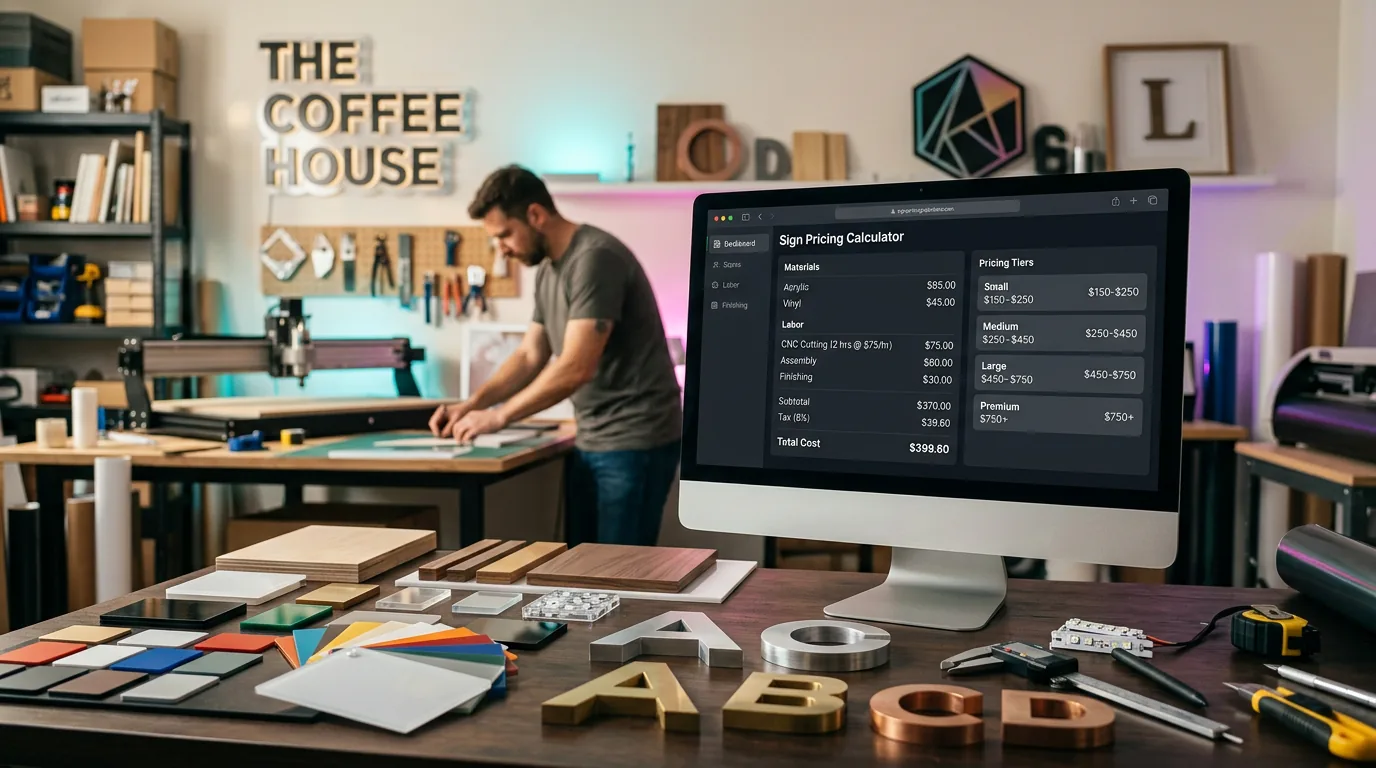
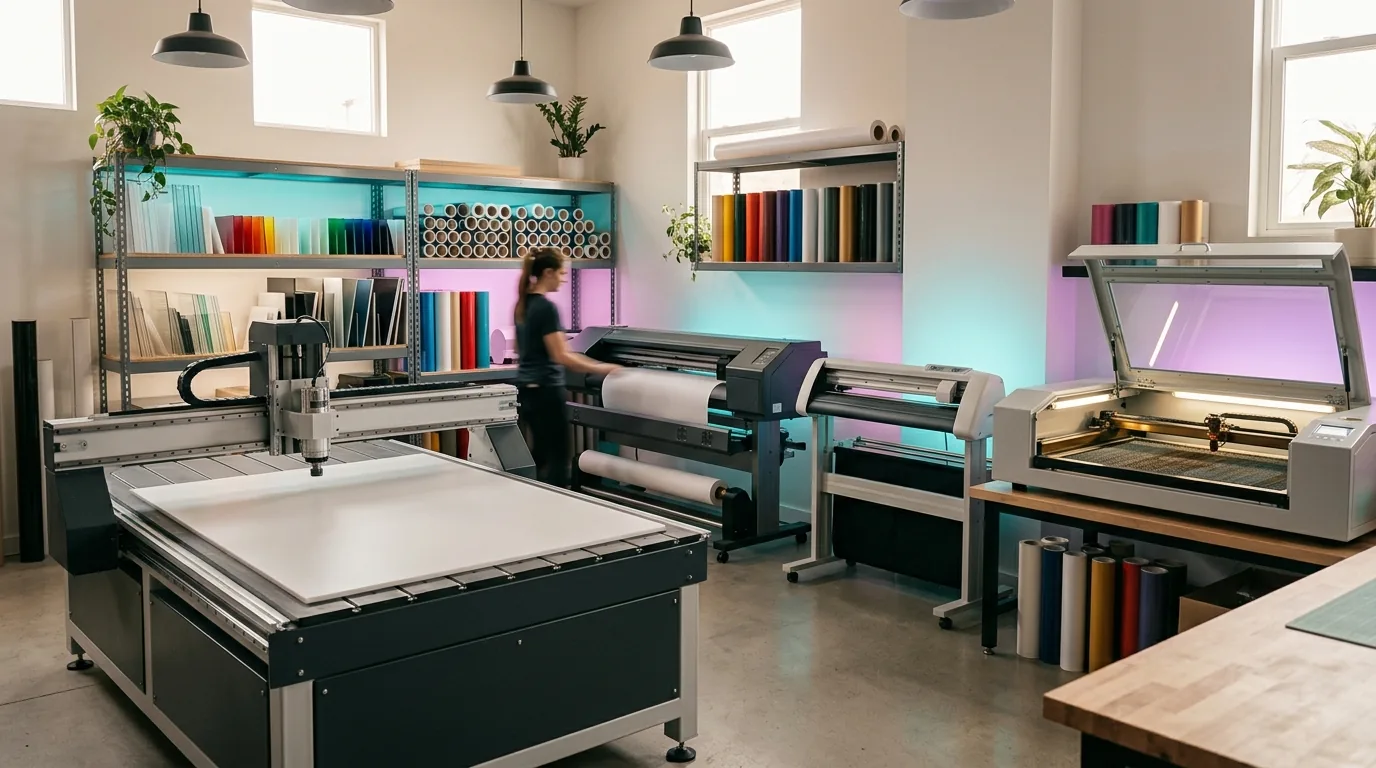
Buy sign making equipment for the signs you sell, and buy the rest from trade makers. At US prices on 2 October 2026, a vinyl cutter, a 64-inch printer and a laminator cost about $30,000 to $51,000 together. Cut and dimensional signs add a CO2 laser ($2,999 to $8,367) or a CNC router ($3,800 to $65,995 and up).
Online LED neon stores can start with no machines. More than 9 in 10 of the stores that took add-to-cart quotes through Sign Customiser in the 12 months to 28 September 2026 sold LED neon (how we counted). LED neon is usually made with a CO2 laser and a soldering bench, not a router, and you can buy it finished from a trade maker.
We make Sign Customiser, software that lets a sign shop’s customers design and price a custom sign on the shop’s own website. Every machine price in this guide was read on 2 October 2026 from the manufacturer or a named US dealer. The few figures that come from search listings or a maker’s own claim say so.
On this page:
- Sign making equipment and 2026 prices at a glance
- Start with the signs you sell
- Vinyl cutters
- Wide-format printers and print-and-cut
- Laminators, hand tools and application tables
- UV flatbed printers
- CNC routers for sign making
- Laser cutters: CO2 and fibre
- Channel letter and illuminated sign equipment
- Software and files that run the machines
- What sign shops bought in 2025
- Should you buy a machine or outsource?
- A buying order for three kinds of shop
- Running costs, tax and finance
- Five purchases to avoid
- Where Sign Customiser fits
- How we counted
- Frequently asked questions
Sign making equipment and 2026 prices at a glance
Every price below is in US dollars, from a US dealer or the manufacturer, read on 2 October 2026. Freight, installation, training and tax are extra unless the listing says otherwise.
| Machine | What it makes | Example models and price | Buy it when |
|---|---|---|---|
| Vinyl cutter | Cut lettering, window and vehicle graphics, stencils | Graphtec CE8000-60 (24 in) $1,995; Summa S One D120 (48 in) $5,290 | You cut vinyl every week |
| Print-and-cut printer | Stickers, decals, printed vinyl cut to shape | Roland BN2-20A (20 in desktop) $7,495; Roland TrueVIS VG4-640 (64 in) $16,295 | You sell printed decals or labels |
| Roll-to-roll printer | Banners, printed vinyl, wall and window graphics | PrismJET 54 package $9,995; HP Latex 630 W $19,745; HP Latex 830 W $34,595 | Printed work fills about 10 hours a week |
| Laminator | Protects prints and mounts them to boards | GFP 563TH-4RS (63 in) $11,395 | You own a roll printer |
| UV flatbed printer | Prints straight onto acrylic, aluminium composite, wood and corrugated board | Mutoh XpertJet 461UF (19 x 13 in bed) $18,995; Mimaki JFX200-2513EX (98 x 51 in) about $74,000 with installation | You print rigid boards most days |
| CNC router | Cut letters, routed and carved signs, panels | Shapeoko 5.1 Pro 4 x 4 ft $3,800 (no spindle); Laguna SmartShop M from $39,495; ShopSabre IS-M from $65,995 | You cut sheet material or letters every week |
| CO2 laser | LED neon backboards, acrylic and wood letters, engraved plaques | xTool P2S 55 W $2,999; Boss Laser LS-1630 from $7,197 (80 W) or $8,367 (105 W) | You cut acrylic or thin wood every week |
| Fibre laser cutter | Cut-out metal signs and letters | Boss Laser FC-EcoCUT $49,997; FC EcoPro $55,997 | Metal signs are a core product |
| Channel letter bender | Channel letter returns | Branded machines are sold by quote | You make channel letters every week |
The spread inside each row is large. A $3,800 hobby-class router and a $66,000 industrial router both cut signs, but the second has a full-sheet bed, a vacuum-ready table and an industrial spindle. What you should pay depends on what you make, how often, and how much labour the machine saves.
Start with the signs you sell
Choose sign making equipment from the list of signs you sell: buy the machines those signs need every week, and buy anything you make once a month from a trade maker.
| Sign type | Machines to make it in-house | Can you buy it from the trade? |
|---|---|---|
| LED neon | CO2 laser for the acrylic backboard, LED neon flex, a soldering bench, power supplies; a UV printer for printed backboards (optional) | Yes. Trade neon makers ship white-label or direct to your customer |
| Channel letters | Channel letter bender, router or laser for faces and backs, LED modules and power supplies, a sign listing in the US | Yes. Wholesale channel letter makers sell to sign shops |
| Lightbox signs | Printer for the face, router or saw for the frame, LED modules | Yes |
| Acrylic and flat-cut letters | CO2 laser for thin material, CNC router for thick | Yes |
| Cut-out metal signs | Fibre laser cutter | Yes. Laser cutting services cut from your file |
| Wood and routed signs | CNC router, a finishing and paint area | Partly |
| Cut vinyl lettering and vehicle graphics | Vinyl cutter, application tools | Rarely worth it; this is the entry product |
| Banners, decals and printed graphics | Roll-to-roll or print-and-cut printer, laminator | Yes. Trade printers sell to sign shops |
| Rigid printed panels and yard signs | UV flatbed printer, or a roll printer, laminator and mounting | Yes |
| Stencils | Vinyl cutter, router or laser, depending on the material | Yes |
Sign Customiser’s own data changes the list. Of the stores that took add-to-cart quotes through Sign Customiser between 29 September 2025 and 28 September 2026, more than 9 in 10 sold LED neon (we counted stores, not orders, and left out test, staff, development and demo stores). That is the online market Sign Customiser sees, not the whole sign industry, and our store base may lean towards LED neon. Read it as what Sign Customiser stores sell, not as a market share. A local sign company that installs storefront signs sells a different mix.
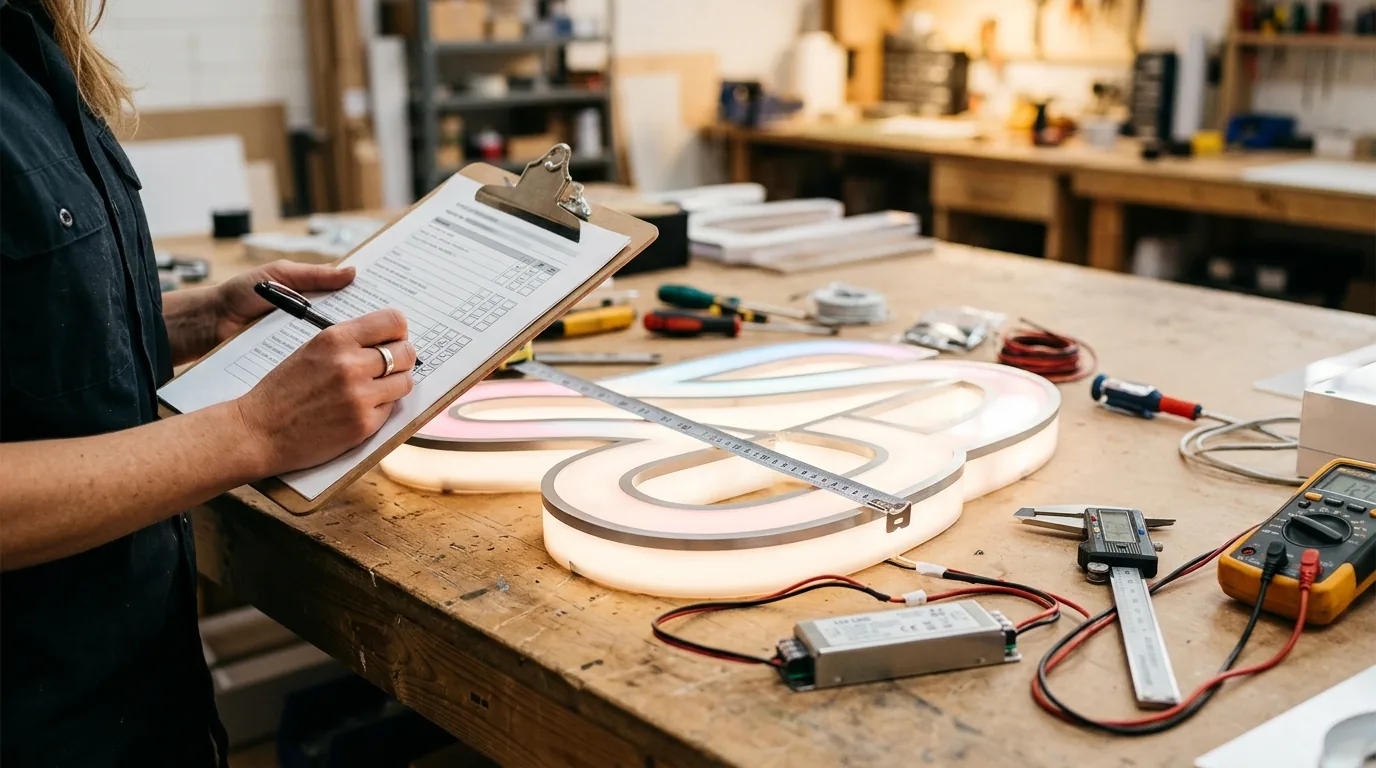
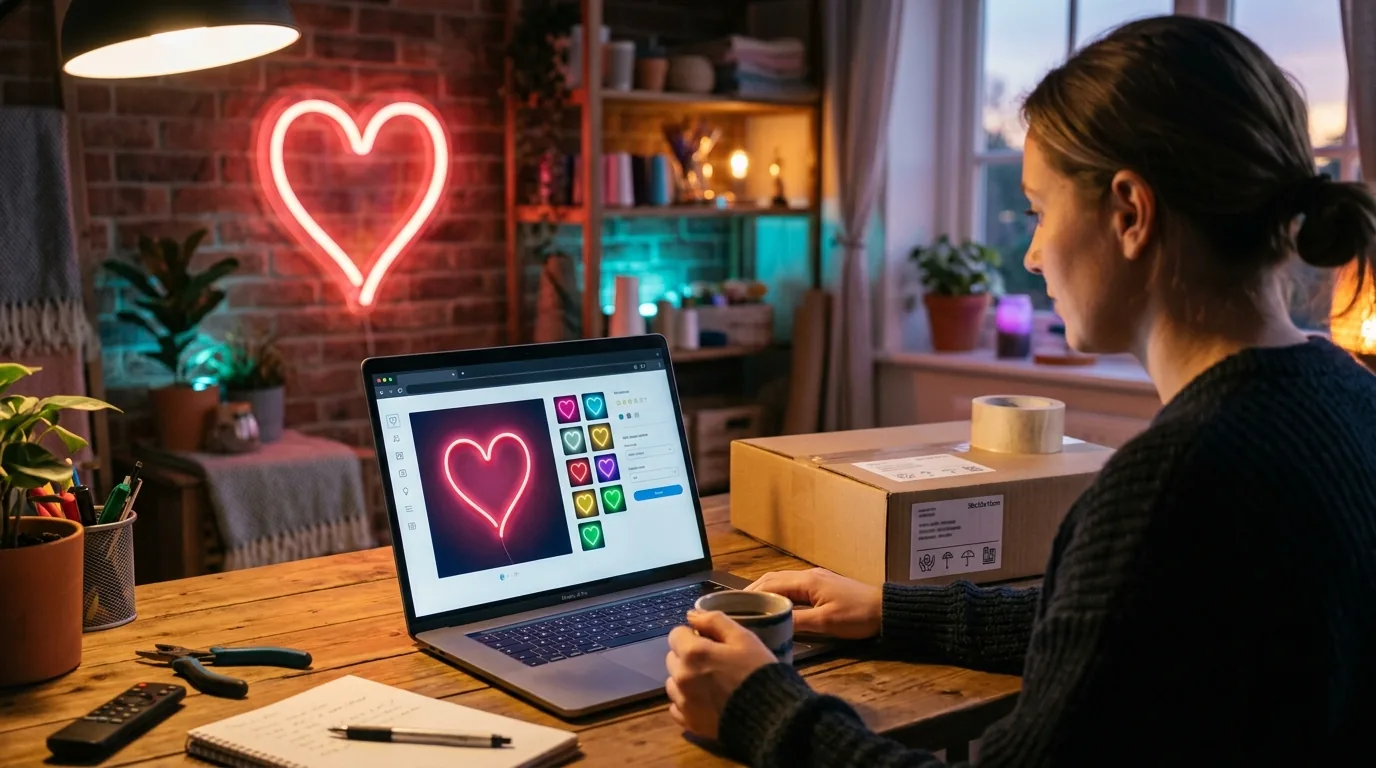
The LED neon share changes the shopping list for an online sign store. An LED neon sign is LED neon flex fixed to an acrylic backboard and wired to a power supply, and sign sellers usually cut that backboard on a laser. The core machine is a CO2 laser. A vinyl cutter, a wide-format printer and a CNC router, the three machines most guides put first, do little for an LED neon store.
An online neon store does not have to make anything. It can sell the design and the price, and a trade maker builds and ships the sign. Neon Designs, for example, runs a trade programme for sign shops with wholesale prices, white-label or blind shipping, and standard production of 7 to 14 business days. Our guide to starting an LED neon sign business on Shopify covers that model. If you make LED neon yourself, the LED neon production process covers the bench work.
Vinyl cutters
A vinyl cutter (also called a plotter or cutting plotter) drags a small blade through self-adhesive vinyl on a roll, following the paths in a vector file. It makes cut lettering, window and vehicle graphics, wall graphics and paint masks. For most graphics shops, a vinyl cutter is still the first production machine: it is cheap and small, and it earns money from the first job.
What it costs in 2026. On 2 October 2026, USCutter listed the Graphtec CE8000-60, a 24-inch cutter, at $1,995 with a 2-year limited warranty, and the Roland CAMM-1 GS2-24, also 24 inches, at $1,995. Airmark listed the Summa S One D120, a 48-inch drag-knife cutter, at $5,290. USCutter’s own MH-series starter kits, with software, were listed at $449.99 to $749.99, but every one was out of stock.
What to look for:
- Width. A 24-inch cutter covers window lettering and most vehicle door graphics. A 48-inch or wider cutter takes 48-inch vinyl rolls without a seam, which matters for vehicle and wall graphics.
- Optical registration. To cut around printed graphics, the cutter needs a sensor that reads registration marks. Check that the model you buy has one.
- Force. Reflective vinyl, sandblast resist and thick stencil material need more blade force than standard sign vinyl. Check the maximum force against the materials you cut.
Print or cut? Many shops now print graphics they once cut from coloured vinyl. In a 2018 Signs101 thread on cut vinyl and printing, members said printing is much faster than cutting and weeding the same job. Others replied that cast cut vinyl lasts 9 to 10 years or more outdoors, against 5 years at best for printed graphics. Keep the cutter for long-life outdoor lettering and for cutting printed work to shape.
Wide-format printers and print-and-cut
A wide-format printer (also called a large-format printer) prints on rolls of vinyl, banner, paper and fabric. A wide-format printer turns a cut-vinyl shop into a graphics shop, and it is often the largest purchase in a graphics shop’s early years.
The ink types:
- Eco-solvent. A common sign printer ink. Durable outdoors, and prints on uncoated vinyl. Roland says its TrueVIS eco-solvent ink is GREENGUARD Gold certified and needs no special ventilation. That is a claim for that ink, not for every solvent printer, so check the specification of the model you buy.
- Latex. HP’s water-based ink. HP says prints come out of the printer dry, so you can laminate or install them at once.
- UV-curable. Cured by UV light as it prints. On a flatbed it prints straight onto rigid boards; see UV flatbed printers.
Print-and-cut. A print-and-cut printer prints and then cuts around the print in one machine. It is the right first printer for a shop that sells stickers, decals and labels. Roland’s VersaSTUDIO BN2-20A, a 20-inch desktop eco-solvent print-and-cut, was $7,495 at USCutter on 2 October 2026. The 64-inch Roland TrueVIS VG4-640, the generation after the VG3, was $16,295 at Airmark. A separate printer and cutter do the same job faster on long runs, because the cutter works while the printer prints the next job.
Roll-to-roll printers. On 2 October 2026, USCutter listed the HP Latex 630 W (64 inches, with white ink) at $19,745. The page showed an MSRP of $24,375 and an HP instant rebate of up to $1,250 that ended on 30 September 2026, so expect the price to move. The newer HP Latex 730 was $21,845, the 830 was $32,345 and the 830 W was $34,595. Epson’s list price for the SureColor S9170, its 64-inch solvent printer, is $29,995. Among cheaper eco-solvent printers, SignWarehouse listed a PrismJET 54-inch ValuPrint package at $9,995.
What to look for:
- Width. 54 or 64 inches. A 64-inch printer prints a 5 ft banner in one piece.
- Local service. A printer that is down for a week costs more than the price gap between two brands. Ask the dealer who repairs it, how far away they are, and what a service contract costs.
- Ink cost. In October 2026, US dealers listed HP 832 latex ink at about $164 a litre. The running costs section has more.
Laminators, hand tools and application tables
A laminator puts a clear film over a print to protect it from UV light and scratches, and it mounts prints onto rigid boards. Buy a laminator with your first roll printer, not later. An unlaminated vehicle or floor graphic wears out early, and a laminator mounts prints to board flatter and faster than hand work.
What it costs in 2026. On 2 October 2026, USCutter listed the GFP 563TH-4RS, a 63-inch top-heat laminator with a rewind and slitter, at $11,395, with a 2-year parts and labour warranty. Match the laminator width to the printer width.
Sign making hand tools. Hand tools are cheap, and you will buy most of them in the first month: felt-edge squeegees, a safety ruler, snap-blade knives, knifeless tape, a heat gun, a laser measure, rivet brushes for vehicle work and a large flat application table.
Roller application tables. In a 2022 Signs of the Times feature where sign makers named their favourite tools, several picked a roller application table: a flat table with a heavy roller on a rail that applies vinyl to boards without bubbles. One shop said it wished it had bought one sooner. If you mount prints to boards every day, it is the next table to buy.
Saws and finishing. Shops that make panels also need a way to cut sheet material to size: a vertical panel saw for aluminium composite and foam board, or a CNC router. Banner work adds a grommet press and a way to hem or weld banner edges.
UV flatbed printers
A UV flatbed prints straight onto rigid material laid flat on its bed: acrylic, aluminium composite, foam board, wood, glass and corrugated plastic. White ink lets it print on clear and dark material. A UV flatbed removes the print, laminate and mount steps for rigid signs, which is why shops that make many panels buy one.
What it costs in 2026. The entry point is a benchtop UV printer with a small bed. On 2 October 2026, SignWarehouse listed the Mutoh XpertJet 461UF, with a 19 x 13 inch bed, at $18,995 after a $2,000 rebate, and USCutter listed the Roland VersaOBJECT MO-180 at $27,995. A large-format flatbed is a different class. SignWarehouse listed the Mimaki JFX200-2513EX, with a 98 x 51 inch print area, at about $74,000 including its required $2,500 installation option.
The hidden cost. A flatbed costs money when it sits idle. In a 2021 Signs101 thread, one owner told a buyer to expect well over $3,000 a year for a service contract, and said a single printhead strike, when the head hits the material, can cost more than $10,000. In the same thread, another member worked out that 5,000 yard signs a year is about 100 a week, and said that volume did not justify an expensive flatbed.
Who should buy one. Buy a flatbed when you print rigid boards most days, or when you sell printed acrylic, such as LED neon backboards with a printed image, in volume. A benchtop UV printer suits small plaques and personalised products. It will not print a full sheet.
CNC routers for sign making
A CNC router moves a spinning cutter over a sheet, following the paths in a vector file. It cuts letters and shapes from acrylic, aluminium composite, PVC foam board, MDF, wood and HDU (high-density urethane), carves 3D and V-carved signs, and cuts panels and lightbox parts. With a CNC router, a graphics shop can sell dimensional signs.
What it costs in 2026. On 2 October 2026:
- Hobby class. Carbide 3D sold the Shapeoko 5.1 Pro, a 4 x 4 ft machine, for $3,800 without legs. You supply the router or spindle.
- 4 x 8 ft machines. Avid CNC listed its PRO4896 4 x 8 ft machine at $11,389 with control electronics, a 4 HP spindle and a leg kit.
- Production machines. Laguna Tools listed the SmartShop M, with a 6 HP spindle, from $39,495, and its larger SmartShop models from $53,995 to $200,000 and more. ShopSabre’s IS-M series started at $65,995 with an industrial spindle and a 4-zone vacuum-ready table.
What separates a sign router from a hobby router:
- Bed size. A 4 x 8 ft (1220 x 2440 mm) bed takes a full sheet of acrylic or aluminium composite. Smaller beds mean cutting sheets down before you route.
- Vacuum hold-down. A vacuum table holds the sheet flat with no clamps in the way, so you can cut a whole sheet of letters in one run. In a 2012 Signs101 thread on router regrets, one owner’s regret was a 3 x 3 ft table with no vacuum.
- Spindle and tool changer. A larger spindle cuts thick material faster. An automatic tool changer swaps between roughing, finishing and engraving bits without stopping.
- Power and dust. Check the power supply before you order. ShopBot’s spindles, for example, need a 220 V single-phase or 230 V three-phase supply. Every router needs dust collection, and it is rarely in the base price.
The objection. A router is a large purchase that some shops never keep busy. In a 2018 Signs101 thread for a new shop, one member said that using a CNC router as a glorified jigsaw was not a practical use of money. Other members said a router pays when you cut the same shape again and again, such as hundreds of aluminium composite signs. In the older router-regrets thread, most regrets were about buying too late or too small. If you already send out routing every week, those owners’ experience points to buying.
Laser cutters: CO2 and fibre
A laser cutter focuses a beam to cut or engrave material with no physical tool. There are two kinds, and they do different jobs.
CO2 lasers cut and engrave acrylic, wood, MDF, paper, fabric and leather. Trotec and Epilog both say a CO2 laser can cut acrylic with a glossy, flame-polished edge straight off the machine, which is why it suits LED neon backboards and acrylic letters. On 2 October 2026, xTool sold its 55 W P2S desktop laser for $2,999 on sale (from $4,499). Boss Laser listed its LS-1630, with a 16 x 30 inch bed, from $7,197 with an 80 W tube and from $8,367 with a 105 W tube. Epilog does not publish prices for its Fusion Pro range; you request a quote from a distributor.
Fibre laser cutters cut sheet metal: steel, stainless steel and aluminium. They make cut-out metal signs and letters, and they cost much more. On 2 October 2026, Boss Laser listed its FC-EcoCUT at $49,997 and its FC EcoPro at $55,997. Small fibre markers, the kind used to mark metal plaques, are a different machine: Boss Laser says they mark and engrave metal but do not cut it. Our guide to custom laser cut metal signs covers when to cut metal in-house and when to send it out.
What a sign-shop CO2 laser must not do:
- Cut PVC or unknown vinyl. Heated PVC gives off chlorine gases (hydrogen chloride), which harm people and corrode the laser. Use a router or a knife for PVC foam board.
- Cut sheet metal. Boss Laser says only high-power CO2 lasers cut thin sheet metal, and that cutting metal is a fibre laser’s job. A desktop or sign-shop CO2 laser is not a metal cutter.
Extraction. Every laser needs fume extraction, either ducted outside or through a filter unit. Budget for it with the machine.
Channel letter and illuminated sign equipment
Channel letters are 3D letters with metal or plastic sides (returns), a back, and usually an acrylic face with LEDs inside. Making them in-house takes a channel letter bender to form the returns from coil, a router or laser for faces and backs, a bench for LEDs and wiring, and in the US, a listing for the finished sign.
Benders. Automatic channel letter benders read the letter outline from a file and bend aluminium or steel coil to shape. Branded machines such as Accu-Bend and SDS Automation are sold by quote, and used machines appear on resale sites. We found no current public price for a new branded bender, so this guide does not quote one.
Certification. In the US, section 600.3 of the National Electrical Code (NFPA 70) requires electric signs to be listed and installed to their listing. UL 48 is the standard for electric signs, and the 15th edition of UL 48 was last revised in May 2025. UL’s General Coverage programme lets an enrolled sign maker apply the UL mark to signs it builds at its own site, within an approved scope. The listing belongs to the maker, not to a sign design. A shop that builds illuminated signs for the US needs its signs listed by a Nationally Recognized Testing Laboratory such as UL or Intertek (ETL). In Australia, state regulators require electrical installation work to be done by licensed electricians. In the UK, the sign standard is BS 559-1:2023, which replaced BS 559:2009.
Buying instead of building. The listing requirement is one reason many shops buy channel letters from trade makers. ChannelLetter.com, a US wholesale maker, says a standard order takes about 3 weeks from order to delivery, that a storefront set that retails at around $3,000 runs roughly $1,500 to $1,800 factory-direct, and that every illuminated set it builds is UL certified. It also says it never contacts your end customer. The shop keeps the customer, the permit and the installation.
Software and files that run the machines
Every machine in this guide runs from a file, and the software between the design and the machine is part of the equipment budget.
- Design. Shops design in Illustrator, CorelDRAW or a sign package such as SAi Flexi. Our sign making software guide compares them.
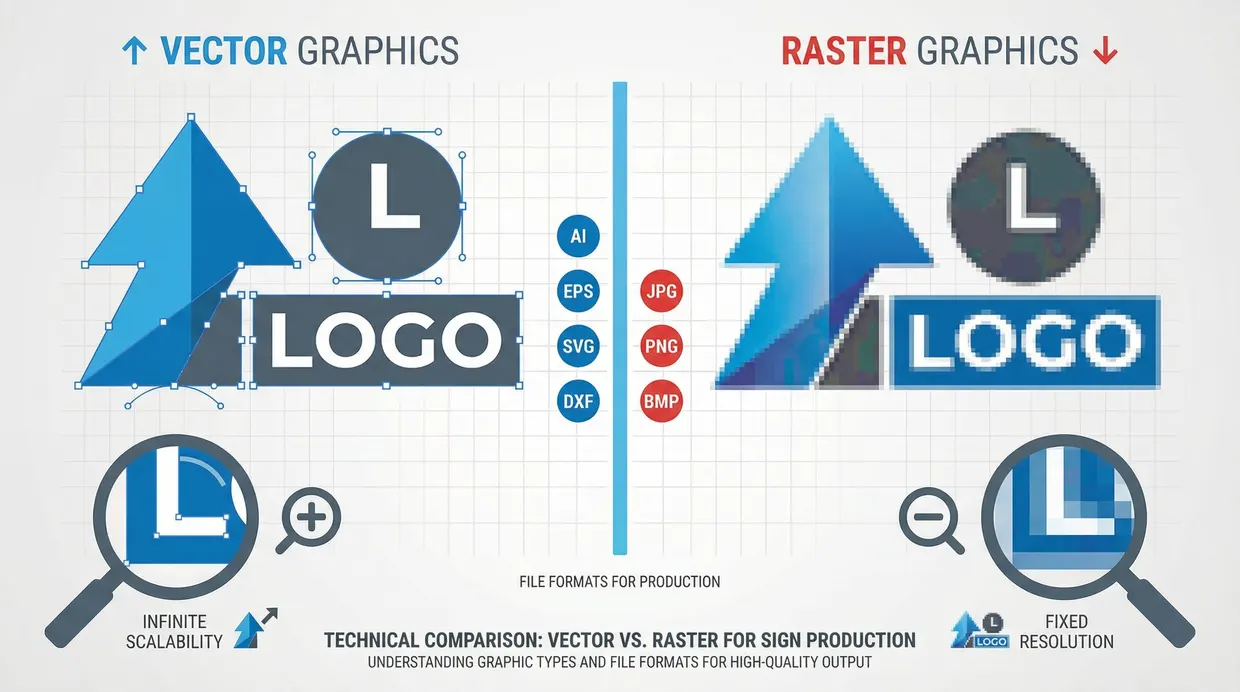
- Cutters. Vinyl cutters run from cut software or a plug-in. USCutter’s starter kits bundle VinylMaster or Sure Cuts A Lot. The cutter reads vector outlines, so a raster logo has to be redrawn first.
- Printers. Wide-format printers print through RIP software, which handles colour and tiling. Ask the dealer which RIP comes with the printer.
- Routers. A router needs CAM software that turns vector shapes into toolpaths. ShopSabre includes Vectric VCarve Pro with its IS-M series.
- Lasers. Lasers take vector cut lines and raster images for engraving, often through the maker’s own software.
The file is where most production errors start: unconverted text, open paths and the wrong scale. Our guide to sign production file formats covers which format each machine needs and how to prepare it.
What sign shops bought in 2025
The best public data on what sign shops buy is the Signs of the Times State of the Sign Industry survey. The 2026 edition, published in March 2026, asked shops what equipment they bought in 2025.
In the Signs of the Times 2026 survey, 51% of shops bought a computer or hardware upgrade in 2025, 32% bought software, 18% a digital printer, 17% a bucket or crane truck, 17% a pickup or other vehicle, 12% a vinyl-cutting plotter, 11% a laminator, 11% a laser engraver or cutter, 9% a 3D printer, 8% a CNC router and 5% a channel letter or metal bender. 12% bought no equipment.
Shops rarely buy big machines: fewer than one in ten bought a CNC router in 2025. The machines most equipment guides spend the most words on are the ones shops buy least often, and nearly as many shops bought a truck as bought a printer.
In the Signs of the Times 2026 survey, 16% of shops spent nothing on equipment in 2025, 27% spent $1 to $10,000, 12% spent $10,000 to $20,000, 13% spent $20,000 to $50,000, 12% spent $50,000 to $100,000 and 20% spent more than $100,000. Most shops (68%) spent $50,000 or less, and one in five spent more than $100,000. The 16% who spent nothing and the 12% who bought no equipment come from two different questions in the survey.
These figures come from the shops that answered the survey, which Signs of the Times readers fill in. They are not a count of every sign shop.
Should you buy a machine or outsource?
Outsource a product until its machine would run every week. For almost every machine on this list, there is a trade maker who will make the same product and ship it to you or to your customer. Buy a machine only when you will keep it busy.
The utilisation rule. In a 2019 Signs101 thread, “Does anybody run their sign shop without a printer?”, a member gave this rule of thumb: “If you are not doing more than 2 hours of printed work a week, don’t get one. If you are doing 10 hours of digital printwork a week, then you oughta think about putting the money out for a printer, cutter, laminator and someone to run it.” A solo owner in the same thread sent out all his printing and said he made more money installing and brokering jobs than he would by hiring someone to run a printer.
The case for buying. The same member said outsourcing means no control over quality. Owning the machine also lets you say yes to a rush job without waiting on someone else’s queue.
What trade makers sell. Trade makers already build the expensive, high-risk products:
- Channel letters. ChannelLetter.com, a US wholesale maker, says a storefront set that retails at around $3,000 costs a sign shop roughly $1,500 to $1,800 factory-direct, and that every illuminated set it builds is UL certified.
- LED neon. Trade neon makers such as Neon Designs ship white-label or direct to your customer.
- Printed signs. Trade printers print banners, yard signs and rigid panels for sign shops to resell.
- Cut metal. Laser cutting services cut sheet metal from your file.
Find Sign Makers, a directory we run, lists sign makers by location if you want one near you.
The break-even test. Buy the machine that runs most often and outsource the rest. Put the machine’s monthly cost next to the trade bill it replaces. For example, an HP Latex 630 W ($19,745) and a GFP 563TH-4RS laminator ($11,395) cost $31,140. Financed over 5 years at an assumed 10% a year, that is about $660 a month, before ink, service and the operator’s time. A Boss Laser LS-1630 105 W ($8,367) over 3 years at the same assumed rate is about $270 a month. When your monthly trade bill for that product passes the machine’s monthly cost plus running costs and labour, buy. A shop that cuts and prints vinyl every day but sells channel letters twice a month should own a cutter and a printer and buy the letters.
A buying order for three kinds of shop
These budgets use the October 2026 prices in this guide. They leave out the computer, design software, freight, installation and training. Use them as a starting point for your own plan, not as a quote.
1. An online LED neon store. You sell LED neon from your website or Shopify store.
- Start: no machines. Sell the design and the price online and buy finished signs from a trade maker. Your costs are the store, the software and samples.
- Then: a CO2 laser ($2,999 to $8,367 for the machines in this guide) to cut your own acrylic backboards, with LED neon flex, power supplies and a soldering bench, once your trade bill passes the break-even test above.
- Certification: in the US, an LED neon sign is an electric sign, so NEC 600.3 applies. Ask a trade maker whether its signs are listed, and plan for your own listing before you build in-house.
- The test: the laser runs most days, and your cost per sign, including your time, is below the trade price.
2. A vinyl and graphics shop. You sell lettering, decals, banners, and vehicle and window graphics.
- Start: a 24-inch or 48-inch vinyl cutter ($1,995 to $5,290) and application tools.
- Before the printer: send printing to a trade printer until you reach about 10 hours of print work a week.
- Then: a 64-inch printer ($16,295 to $34,595) and a laminator (about $11,400), bought together. Choose a print-and-cut printer if you sell many stickers.
- Later: a UV flatbed, only when rigid printed boards fill most days.
- The test: the printer runs at least 10 hours a week, and laminated prints leave the shop the day they print.
3. A dimensional and illuminated sign shop. You sell cut letters, routed signs, lightboxes and channel letters.
- Start: a vinyl cutter, a 64-inch printer and a laminator, plus a CNC router (from about $11,400 for a 4 x 8 ft machine, to $39,495 to $65,995 or more for a production machine).
- Then: a CO2 laser for acrylic. Add a bender and, in the US, a sign listing, only when channel letters are a weekly product.
- Until then: buy channel letters and LED neon from trade makers and install them yourself.
- The test: the router cuts full sheets of letters on a vacuum table most weeks.
Running costs, tax and finance
The dealer price is not the cost of owning the machine. Plan for these too.
Ink and printheads. In October 2026, US dealers listed HP 832 latex ink at about $164 a litre. HP says its older Latex 300 series costs about 21 cents per square foot to run, with ink, printheads and cleaning included; we found no matching figure for the current 630, 730 and 830. Printheads wear out on every inkjet printer, so ask the dealer what a replacement head costs before you buy.
Service. Budget for a service contract on any printer you depend on. In a 2021 Signs101 thread, one owner put a UV flatbed service contract at well over $3,000 a year.
Space, power and air. Routers need dust collection and, often, a 220 V or three-phase supply. Lasers need extraction. Check the ventilation needs of any solvent printer.
Tax. Machines are business assets, and tax rules can bring the deduction forward:
- US. For tax years beginning in 2026, the section 179 limit is $2,560,000, reduced once you place more than $4,090,000 of equipment in service in the year (IRS Revenue Procedure 2025-32). The One Big Beautiful Bill Act made 100% bonus depreciation permanent for qualifying property acquired and placed in service after 19 January 2025.
- Australia. Small businesses with turnover under A$10 million can immediately write off eligible assets that cost less than A$20,000 each. That threshold covered 2025–26 and is now permanent from 1 July 2026.
- UK. The Annual Investment Allowance gives 100% relief on up to £1 million a year of plant and machinery. Companies can also claim full expensing on new main-rate plant and machinery, and a 40% first-year allowance applies to new main-rate plant bought on or after 1 January 2026, including by unincorporated businesses.
This is not tax advice. Ask your accountant how these rules apply to you before you buy.
Finance. Dealers and equipment lenders finance most of these machines. Compare the monthly payment, plus service and running costs, with the trade bill the machine replaces, as in the break-even test.
Five purchases to avoid
A craft cutter for commercial work. Desktop craft cutters are made for small decals and hobby projects. For window and vehicle lettering, buy a sign cutter that handles full rolls and long runs.
A laser for PVC. If you cut PVC foam board, buy a router or use a knife. Laser-cut PVC gives off corrosive, harmful gases.
A flatbed you will run once a week. The service contract and head care cost the same whether you print or not. If rigid printing is occasional, send it to a trade printer.
A machine with no service nearby. Ask the dealer who repairs the machine and how far away they are before you buy. A machine nobody local can repair stops your production for as long as the repair takes.
A router as a jigsaw. If the job is a few shapes a month, a panel saw, a jigsaw or a trade cutter costs less. A router pays on repeated work.
Where Sign Customiser fits
Sign Customiser is software, not a machine, and we do not make or ship signs. Sign Customiser sits in front of your equipment. Your customers design their sign on your website, see a preview and the live price, and add it to cart. You get the order with the details you need to make it.
For the machines in this guide, that means:
- Vector files with the order. When you turn it on for a customiser (it is off by default), the order email links to an SVG file of the design with the text converted to outlines, plus EPS and AI copies if you want them. Stencil designs can also include a DXF file for cutting software. Lightbox customisers do not make an SVG; when the customer adds text to the front face, the order email links to PNG images of that face. The help centre explains how to set up production files for manufacturing.
- Sizes in the order. The order includes the size the customer chose. For most sign types you scale the file to that size in your cutting software; stencil and cut-out files already come at their real size.
- Your own prices. You set your own prices and price rules for sizes and options, so the quote is right before the job reaches a machine. Our pricing guide for sign shops covers how to set those prices, and the sign proof approval guide covers what the customer should sign off before production.
Every plan includes every feature. Plans start at $29 a month, with a 7-day free trial. See pricing.
How we counted
Equipment prices. Each machine price was read from the manufacturer’s or a US dealer’s page on 2 October 2026, and the article names the model and the seller. One figure is an exception and says so where it appears: HP’s running cost per square foot is HP’s own claim, read from a search excerpt because HP’s page blocked a direct read. Prices are in US dollars and exclude freight, installation, training and tax. Dealer prices include any rebate shown on the day, and we say where a rebate has ended. Where a maker gives prices only on request, we say so. We will check these prices again in April 2027.
Sign Customiser figure. The LED neon share counts stores, not orders. It covers stores that took at least one add-to-cart quote through Sign Customiser between 29 September 2025 and 28 September 2026. It excludes test stores, staff stores, Shopify development stores and our demo store. We checked it a second way, counting only stores with at least five add-to-cart quotes of LED neon or at least five of other sign types combined, and the result was the same. It describes Sign Customiser stores, which sell online. It is not a measure of the whole sign industry.
Survey figures. The purchase, spend and profit figures come from the Signs of the Times 2026 State of the Sign Industry survey, which covers 2025. They are what the shops that answered reported, not a census of all sign shops.
Forum figures. Quotes from Signs101 are single shops giving their own view, with the year of the thread. Treat them as experience, not data.
Finance examples. The monthly costs in the break-even test use an assumed 10% yearly rate and equal monthly payments. Your rate and terms will differ.
Frequently asked questions
What equipment do I need to start a sign shop?
To make cut-vinyl and printed signs, you need a design computer, a vinyl cutter, a wide-format printer, a laminator and hand application tools. Add a CNC router or a CO2 laser when you make cut letters, acrylic or routed signs. If you sell LED neon or channel letters, you can start with no machines and buy the finished signs from a trade maker.
How much does sign making equipment cost?
On 2 October 2026, US dealers and manufacturers listed a 24-inch professional vinyl cutter at $1,995, a 64-inch print-and-cut printer at $16,295, 64-inch HP Latex printers from $19,745 to $34,595, a 63-inch laminator at $11,395, CNC routers from $3,800 (a 4 x 4 ft hobby-class machine without a spindle) to $65,995 and up (industrial), and CO2 lasers from $2,999 to $8,367.
How do I start a sign business?
Choose the signs you will sell first, then buy only the machines those signs need every week. Buy everything else from trade makers until a machine would run every week. An online LED neon store can start with no machines at all: it sells the design and the price, and a trade maker builds and ships the sign.
Is sign making profitable?
For most shops, yes. In the Signs of the Times 2026 State of the Sign Industry survey, 92% of the shops that answered reported a 2025 net profit of 5% of sales or more. The most common answer was 10% to 20% (34% of shops), and 36% reported more than 20%. Only 8% reported under 5%.
What machine do I need to make yard signs?
Yard signs are printed corrugated plastic, so you need a UV flatbed printer to print the board directly, or a roll-to-roll printer and a laminator to print vinyl and mount it. At low volume, many shops buy yard signs from a trade printer instead, because a flatbed carries a service contract and printhead costs whether or not it prints.
How much does a 4x8 sign cost?
It depends on the material, the print, the finishing and the labour, so there is no single price. 4 x 8 ft is the size of a full sheet of aluminium composite or acrylic, which is why production sign routers and large UV flatbeds take a 4 x 8 ft sheet. Price your own from your material cost, your shop rate and your markup.
Should I buy a CNC router or a laser cutter for signs?
Buy a CO2 laser if you mostly cut thin acrylic and wood, such as LED neon backboards and flat-cut letters: it can leave a polished edge on acrylic with no finishing. Buy a CNC router if you cut thick acrylic, aluminium composite, PVC foam board or HDU, or carve 3D signs. A CO2 laser must never cut PVC, and for sheet metal you need a fibre laser cutter.
Is it cheaper to buy sign equipment or outsource the work?
Outsource until a machine would run every week. In a 2019 Signs101 thread, one member gave this rule of thumb: if you are not doing more than 2 hours of printed work a week, do not buy a printer; at about 10 hours a week, think about a printer, cutter, laminator and someone to run them. Trade makers already make channel letters, LED neon and printed signs for sign shops to resell.
What equipment did sign shops buy in 2025?
In the Signs of the Times 2026 State of the Sign Industry survey, 51% of shops bought a computer or hardware upgrade in 2025, 32% bought software, 18% a digital printer, 17% a bucket or crane truck, 17% a pickup or other vehicle, 12% a vinyl-cutting plotter, 11% a laminator, 11% a laser, 9% a 3D printer, 8% a CNC router and 5% a channel letter or metal bender. 12% bought no equipment.
Do illuminated signs need certification?
In the US, section 600.3 of the National Electrical Code (NFPA 70) requires electric signs to be listed, usually to UL 48, the standard for electric signs. In Australia, state regulators require electrical installation work to be done by licensed electricians. In the UK, the sign standard is BS 559-1:2023. Check the rules where you install before you build illuminated signs in-house.